
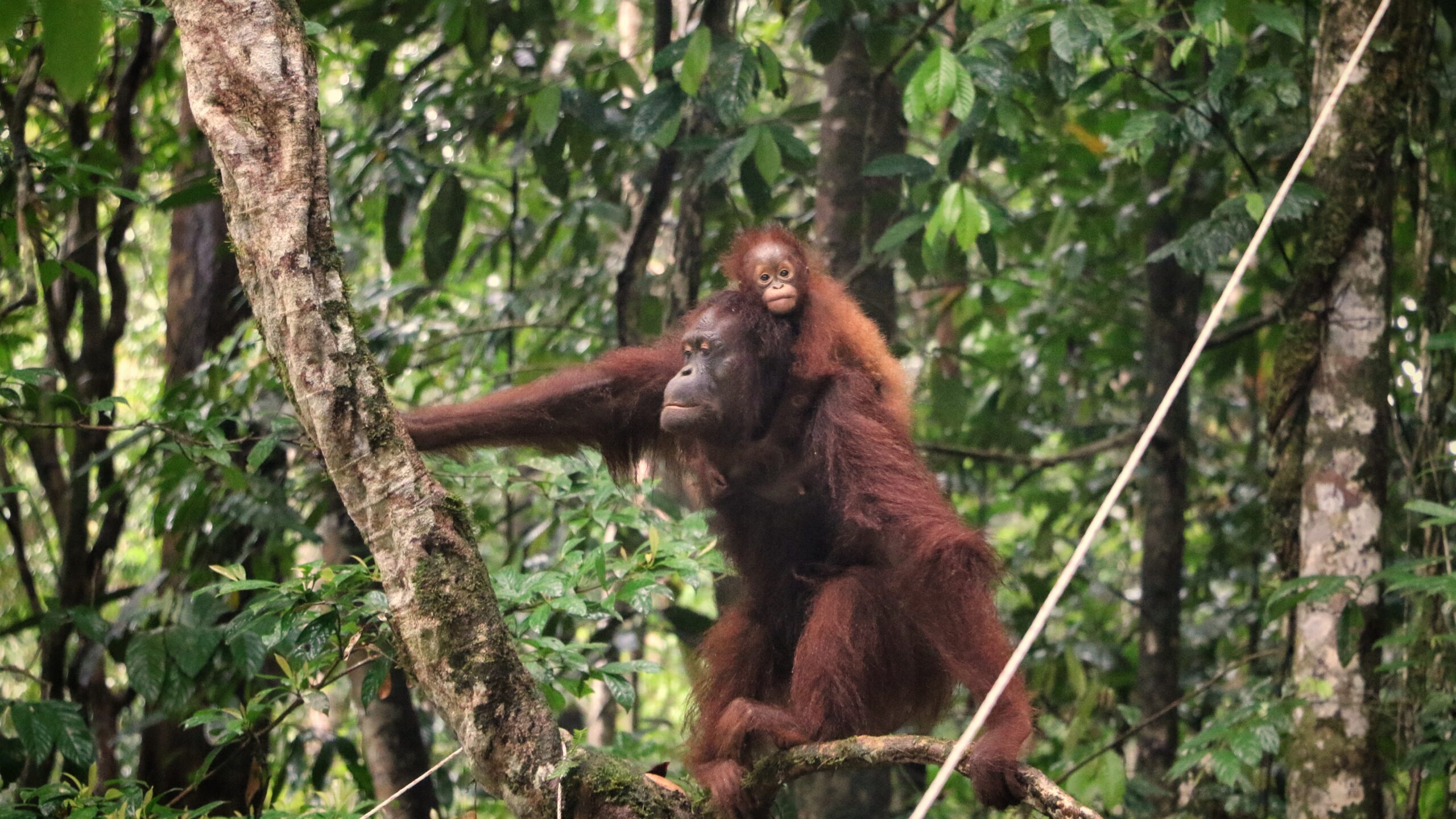
A Sumatran orangutan uses a human-made rope bridge to cross a road, reconnecting fragmented forest habitat.
The moment arrived quietly, recorded by a motion-sensitive camera mounted high in the forest canopy. A young Sumatran orangutan paused at the forest's edge, gripped a rope with deliberate care, and stepped out into open air above a public road. Halfway across the 10-meter span, he stopped, glanced down at the traffic below, then looked toward the camera as if acknowledging the significance of his journey. Then he continued across, completing a crossing that conservationists had been hoping to witness for two years.
The canopy bridge spans the Lagan-Pagindar road in Pakpak Bharat district, a vital corridor connecting remote villages to schools, healthcare, and government services. But this essential infrastructure for people had created a devastating barrier for wildlife. When the road was upgraded in 2024, the widened gap in the forest canopy eliminated natural crossings for tree-dwelling animals, splitting approximately 350 orangutans into two isolated populations in the Siranggas Wildlife Reserve and Sikulaping Protection Forest.
Recognizing that development didn't have to mean destruction, the Sumatran Orangutan Society partnered with Indonesian conservation group TaHuKah and government agencies to install five rope bridges. Each structure required just 200 meters of rope and took only four to five days to construct. The bridges were carefully positioned after extensive surveys of orangutan nests, forest cover, and animal movement patterns, and designed to support the weight of the world's largest tree-dwelling mammals.
For two years, camera traps monitored the bridges around the clock. First came smaller animals—plantain squirrels and black giant squirrels tested the ropes. Then long-tailed macaques, black Sumatran langurs, and agile gibbons began crossing regularly. But orangutans, cautious and deliberate by nature, took their time. Researchers observed them building nests near the bridges, lingering at the edges, testing the ropes gradually. Only when completely certain of safety did this pioneer finally commit to the full crossing.
The stakes for this population couldn't be higher. Sumatran orangutans are classified as critically endangered, with fewer than 14,000 remaining in the wild. When populations become isolated in small groups, inbreeding leads to genetic weakening and eventual functional extinction—where animals still exist but lack the genetic diversity to survive long-term. By restoring connectivity between the two forest patches, the bridges give this orangutan community a fighting chance at maintaining healthy, viable populations.
The success of this first crossing offers hope that extends far beyond one road in Sumatra. Similar bridges have been used by orangutans elsewhere, but typically over rivers or on private forestry roads. Public roads—noisy, busy, and unpredictable—pose far greater challenges. This proof of concept demonstrates that even in the face of necessary human development, simple interventions can stitch fragmented forests back together. Conservationists hope more orangutans will follow their pioneer, and that canopy bridges will become standard features in infrastructure planning across regions where development intersects with critical wildlife habitat.
Source: CBS News